Office Acoustic Privacy: A Practical Design Guide
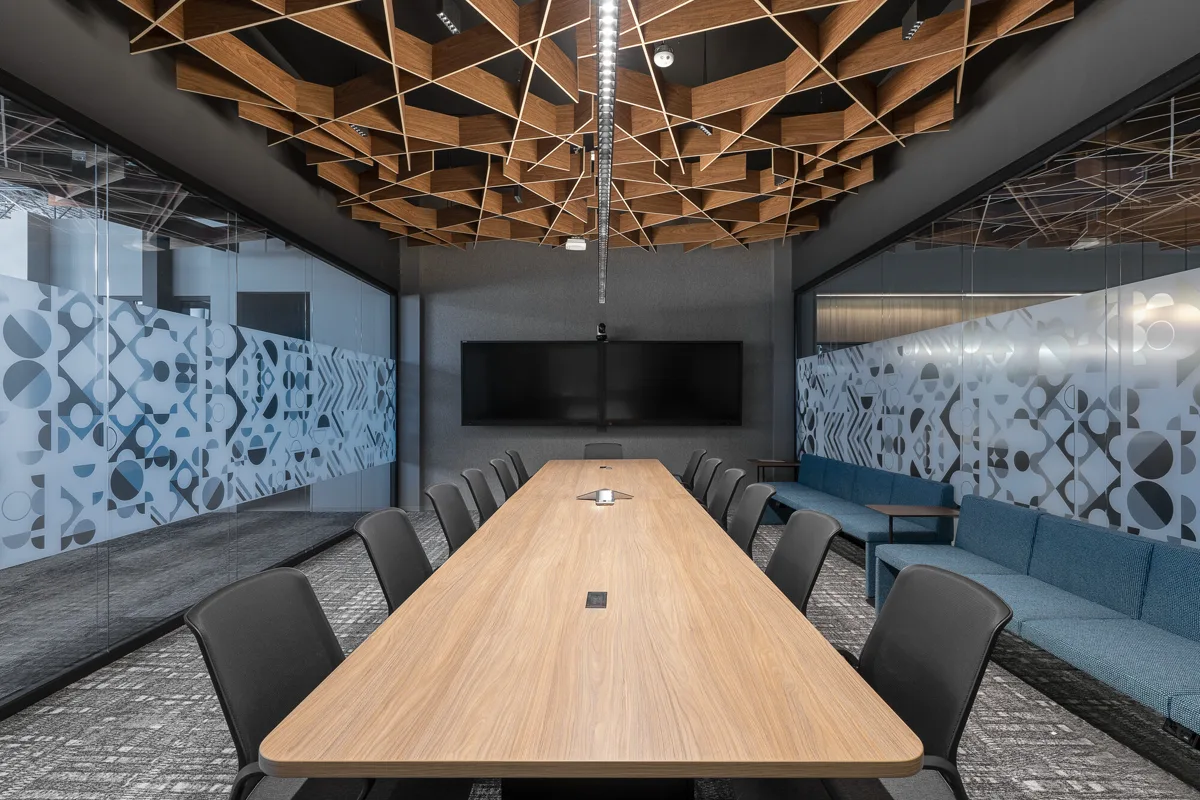
A beautiful conference room can still fail if every conversation is clearly heard outside it.
Office acoustic privacy is not created by one material. It depends on the complete enclosure and on the level of privacy the room actually requires.
Start with the conversation, not the STC number
Different rooms have different privacy needs.
A useful first step is to classify spaces:
Lower privacy
Informal collaboration spaces and rooms where some sound transfer is acceptable.
Normal privacy
General private offices and everyday meeting rooms.
Higher privacy
Executive offices, HR spaces, legal or financial discussions and rooms used for confidential meetings.
The wall strategy should follow the room requirement.
What is STC?
STC, or Sound Transmission Class, is a laboratory rating used to describe how well an assembly reduces airborne sound transmission over a defined frequency range.
A higher STC generally indicates greater sound isolation in the tested assembly.
However, an STC value for a wall or glazing configuration is not automatically the performance of the completed room.
Why the complete enclosure matters
Sound can travel through:
- doors
- door gaps
- perimeter seals
- ceilings
- floors
- penetrations
- adjacent construction
- mechanical systems
A high-performing wall beside a poorly sealed door may not deliver the expected room privacy.
Glass can provide meaningful acoustic separation
Glass offices do not have to mean poor acoustics.
Performance depends on glass thickness, laminated versus tempered glass, the number of panes, airspace, framing and the complete system.
Rampart publishes moodwall configurations tested in accordance with ASTM E90-09.
Published examples include:
| moodwall configuration | Published STC |
|---|---|
| P1/P3 – single 10 mm tempered glass | 27 |
| P1/P3 – single 12 mm tempered glass | 34 |
| P1/P3 – single laminated glass configurations | 35 |
| P4 – double 10 mm tempered glass | 38 |
| P4 – double 10 mm, one tempered + one laminated pane | 45 |
Final enclosure performance depends on doors, seals, interfaces and field conditions.
Single glazing vs. double glazing
Single-glazed systems can be appropriate where transparency, a slim profile and moderate acoustic separation are priorities.
Double glazing provides another layer in the assembly and can support higher sound-isolation requirements.
Rampart's P4 system offers double-glazed configurations and published ratings up to STC 45.
Explore Office Glass Partitions.
Doors deserve special attention
The door is often one of the most important acoustic elements in a room.
During design, coordinate:
- door type
- frame
- perimeter seals
- bottom condition
- hardware
- swing or sliding operation
- accessibility
- required privacy
Do not assume the wall rating automatically applies across the doorway.
Privacy also has a visual component
Acoustic privacy and visual privacy are separate requirements.
A room can be acoustically private while remaining visually transparent. Depending on the design, glass can use films or other treatments where visual screening is needed.
Space planning can reduce acoustic conflicts
Not every acoustic problem needs to be solved by increasing wall performance.
Good planning can separate noisy collaborative areas from rooms requiring concentration or confidentiality.
See Office Space Planning Guide.
Plan for changing room functions
If the workplace is likely to change, consider whether today's meeting room could become tomorrow's private office.
A demountable wall system can support reconfiguration, while selecting the appropriate wall configuration helps address the room's acoustic requirement.
Acoustic design checklist
Before specifying an enclosed office or meeting room, confirm:
- room function
- privacy expectation
- wall configuration
- glazing type
- door type
- perimeter seals
- ceiling interface
- penetrations
- adjacent rooms
- mechanical paths
- applicable test data
Use tested information when specifying
Rampart provides technical information for moodwall systems, including acoustic data and system resources.
Review Rampart technical resources or compare moodwall systems.