STC Ratings for Architectural Walls: What Architects Need to Know
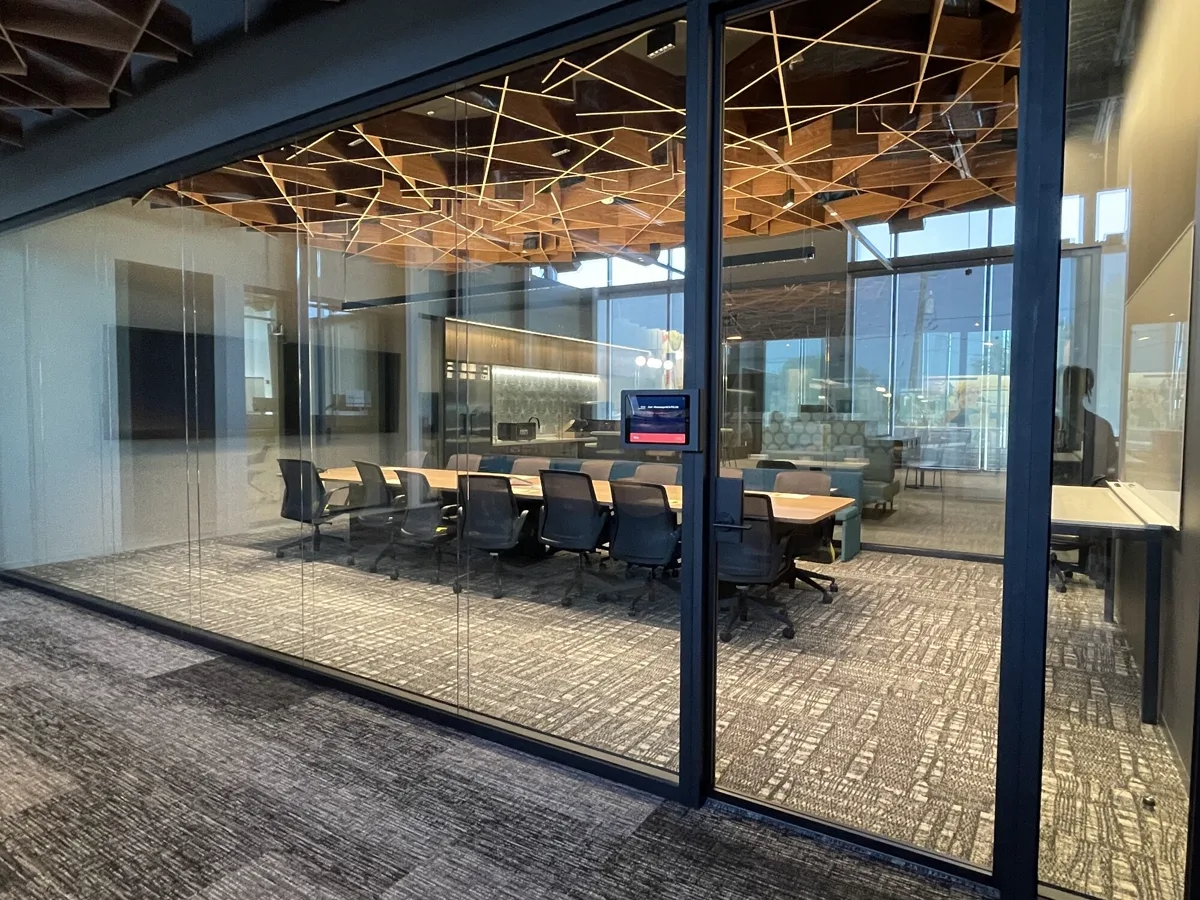
STC is one of the most commonly referenced acoustic ratings in office wall specifications—and one of the easiest numbers to misuse.
What does STC mean?
STC stands for Sound Transmission Class. It summarizes how well an assembly reduces airborne sound transmission across a defined frequency range.
In general, higher STC indicates greater airborne sound isolation.
Tested wall vs. completed room
A laboratory-tested partition is only one part of the room.
Sound can bypass the wall through doors, door undercuts, perimeter gaps, ceilings, floors, mechanical paths, penetrations and adjacent construction.
Rampart published moodwall configurations
Rampart publishes moodwall configurations tested in accordance with ASTM E90-09.
| System | Configuration | Published STC |
|---|---|---|
| P1 / P3 | 10 mm tempered glass | 27 |
| P1 / P3 | 12 mm tempered glass | 34 |
| P1 / P3 | Laminated single-glazed configurations | 35 |
| P4 | Double 10 mm tempered glass | 38 |
| P4 | One tempered + one laminated 10 mm pane | 45 |
Always confirm current technical data when specifying.
What STC should an office have?
There is no universal number. The target depends on room use, background noise, speech privacy expectations, door type, adjacent activities and project criteria.
Glass walls can provide meaningful acoustic separation
Performance depends on glass thickness, laminated vs. tempered glass, number of panes, airspace, framing, seals and doors.
Doors often control performance
A high-performing wall beside a weak door can underperform.
See Doors and Hardware for Glass Wall Systems.
Do not mix test data casually
Use test data for the actual proposed system and assembly. Do not assume a glass-only test equals the complete room.
Coordinate acoustics with room planning
Adjacency can be as important as wall performance.
See Office Wall System Design Guide.
Acoustic specification checklist
Confirm required privacy level, tested wall configuration, glass type, number of panes, door type, seals, ceiling and floor interfaces, penetrations and applicable test standard.
Explore Architectural Wall Systems and Rampart Resources.